|
|||
|
An
Organization Dedicated to the Preservation of Railroad History |
|||
 |
|||
| 77 Washington Street, South Norwalk, CT | Monthly
Meeting on the Fourth Monday |
||
     |
|||
Happy New Year!
2004 National Convention
Welcome New Member! Dan Gallo, Jr. - Tarrytown, NY
From Add Austin EVERYTHING HAS A HISTORY Here is a look into the corporate mind that is very interesting, educational, historical, completely true, and hysterical, all at the same time! It forms an interesting note on how history evolves (or doesn’t). The United States standard railroad gauge (width between the two rails) is 4 feet, 8.5 inches. That’s an exceedingly odd number. Why was that gauge used? Because that’s the way they built them in England, and English expatriates built the US railroads. Why did the English build them like that? Because the first rail lines were built by the same people who built the pre-railroad tramways, and that’s the gauge they used. Why did “they” use that gauge then? Because the people who built the tramways used the same jigs and tools that they used for building wagons, which used that wheel spacing. Why did the wagons have that particular odd wheel spacing? Well, if they tried to use any other spacing, the wagon wheels would break on some of the old, long distance roads in England, because that’s the spacing of the wheel ruts on those long, old roads. So who built those old rutted roads? The first long distance roads in Europe (and England) were built by Imperial Rome for their legions. The roads have been used ever since. And the ruts in the roads? Roman war chariots first formed the initial ruts, which everyone else had to match for fear of destroying their wagon wheels. Since the chariots were made for (or by) Imperial Rome, they were all alike in the matter of wheel spacing. The US standard railroad gauge of 4 feet, 8.5 inches derives from the original specification for an Imperial Roman war chariot! Specifications and bureaucracies live forever! So the next time you are handed a specification and wonder what horse’s ass came up with it, you may be exactly right, because the Imperial Roman war chariots were made just wide enough to accommodate the back ends of two war horses. Thus, we have the answer to the original question. Now a twist ----- There’s an interesting extension to the story about the railroad gauges and horses’ behinds. When we see a Space Shuttle sitting on its launch pad, there are two big booster rockets attached to the sides of the main fuel tank. These are solid rocket boosters, or SRBs. The SRBs are made by Thiokol at their factory in Utah. The engineers who designed the SRGs might have preferred to make them a bit fatter, but the SRBs had to be shipped by train from the factory to the launch site. The railroad line from the factory had to run through a tunnel in the mountains. The SRBs had to fit through that tunnel. The tunnel is slightly wider than the railroad track, and the railroad track is about as wide as two horses’ behinds! So, the major design feature of what is arguably the world’s most advanced transportation system was determined over two thousand years ago by the width of a Horse’s Ass!
From Robert Briechle A little bit of “Home”, so far away! Here are five photos of New Zealand Government Railways JA-class 4-8-2 #1211 which is in service on excursions all over the country under auspices of Mainline Steam Trust. The station photos were taken in Wellington (the capitol) and, indeed, over the top of the locomotive in one photo, one can see The Beehive, the building that houses the New Zealand government. The styling of this class (this loco built by North British Loco Works, others in the J-class in NZGR shops) was patterned after the NewHaven I-5 4-6-4’s.
Auction
This beautiful Union Pacific 24 X 30 Framed Cibachrome print could be yours! Original photo was taken by Tim Broadley Bidding starts at only $150.00 Please call Jim Mescher at (201) 391-7362 Or mail you bid to: Proceeds from this auction benefit the Western Connecticut Chapter.
News Years day - Southern Railroad Co. of New Jersey Former Maine Central Caboose at Winslow New Jersey
Gift Shop Special Click Here for more information.
Railroading and rail history are great parts of America's history, but safety must always play a part when you are near the tracks. That's why the NRHS is a full and official supporter of the Operation Lifesaver (OLI) Program. Operation Lifesaver is a non-profit organization that promotes grade crossing safety and railroad trespassing concerns. Near the tracks, be safe & stay alive! Some important facts:
When near the rails, think safety! Always expect a train!
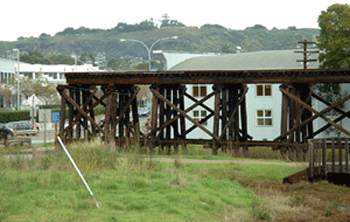
Mystery Photo
While this is only a fraction of it’s former self, this NP trestle was featured in a very dramatic scene in a 70’s movie filmed in the San Francisco Bay Area. Can you identify the movie and the scene? Get your response to Rick Mount (rickmt@localnet.com) or 203-226-2743 Those who with the correct identification will be announced in the February Manifest.
The SONO Switch
Tower Museum The SONO Switch Tower Museum Please help us show the Tower and how it operated to the public. Volunteer Hours for December: To volunteer, contact Jim Mescher at: (201) 391-7362
Thank you. Up Coming Events Big 2005 Railroad Hobby Show: Amherst Railway Society – www.amherstrail.org Saturday January 29th, 2005 - 9 AM to 5 PM & Sunday January 30th, 2005 10 AM to 5 PM. Eastern States Exposition Grounds 1305 Memorial Ave. West Springfield, MA Better Living Center – Young Building – Stroh Building Daily Admission Adults: $8.00 Children under 12 $1.00 Parking $5.00 Nearly 5 ½ acres of Railroading Look for us in the Young Building!
Annual Spring Train Meet Presented by The Westchester Model Railroad Club Sunday, March 20th, 2005 - 10:00 am - 3:00 pm Greenwich Civic Center Old, Greenwich, CT Admission: Adults $6.00 Senior: $4.00 Family: $8.00 Senior & Spouse: $6.00 - Under 12 free with adult Plan to volunteer at the Sono Switch Tower table or be sure to visit us.
Our Next Chapter meeting will be Entertainment this month will be provided by: Bob Gambling Bob Gambling will provide refreshments.
|
|||
 |
|||
|
|||
|
|||


.gif)
.gif)
.gif)
.gif)
.gif)
.gif)
.gif)
.gif)